The Scales of Silence: Inside the Pangolin Trafficking Network That Fed on 77,000 Animals

Find the wanderlust in the mundane, and the heartbreak hiding in plain sight.
⚠️ CONTENT WARNING This article discusses wildlife crime and includes images of pangolins that have been killed and butchered, as well as seized animal parts. Some readers may find them distressing. Graphic images are clearly marked and appear further down the page.

A Creature Made of Moonlight and Armour
Let me begin with the part that makes you smile.
There is a creature that wanders the African night in a suit of armour, as though a medieval knight had wandered out of a storybook and decided to take up ant-hunting instead. It has a long, patient tongue, a soft little face, dark curious eyes, and a habit of curling into a perfect, glorious ball when the world becomes too much.
It is the pangolin. And if you have ever held one, as I have been blessed to be near one, you will know that the moment is not easily forgotten. They are gentle, strange, and quietly magical. They ask for nothing. They simply go about their business of keeping the bush in balance, eating ants and termites by the million, aerating the soil as they dig, and making the world a little healthier by existing in it.
Those scales that look like fairytale armour? They are made of keratin, the very same substance as your fingernails and mine. There is nothing medicinal, magical or miraculous about them. And yet, for years, that armour has been the very reason these gentle creatures are being hunted to the edge of the unthinkable.

Meet the Pangolin: Nature's Quiet Engineer
Before we talk about the crime, let us properly meet the victim, because most people have never had the pleasure.
There are eight species of pangolin in the world: four in Africa and four in Asia. They are the only mammals on Earth covered in true scales, and they wear them from the crown of the head to the tip of a muscular tail. In southern Africa, the one most of us might be lucky enough to glimpse is the ground pangolin, a shy, solitary, night-roaming wanderer that most people will never see in a lifetime of safaris.
Their lives are wonderfully strange. A pangolin has no teeth. Instead, it has a sticky tongue that, when stretched out, can be longer than its own body, perfect for slipping into termite mounds and ant nests. Its front claws are built for digging, and every burrow it opens becomes a little shelter, a little water catchment and a little garden bed for other creatures. A mother usually raises a single baby at a time, and the youngster rides on the base of her tail like a tiny passenger on a scaled train.
That slow, single-baby rhythm is exactly what makes them so vulnerable. A species that raises one youngster at a time cannot out-breed a trade that takes tens of thousands. And they are famously delicate: they struggle in captivity, they stress easily, and they rarely forgive being taken from the wild. For the pangolin, a gentle life is the only life it knows how to live.
A Night in the Life of a Pangolin
If you could follow a pangolin through one ordinary night, you would be in for a slow, delightful education.
As dusk settles, it emerges from its burrow or hollow and begins to shuffle through the grass, nose low, guided far more by smell than by sight, since its eyesight is poor. Every so often it rises onto its hind legs to sniff the air, using that long tail as a counterweight, looking for all the world like a tiny, armoured dinosaur out for an evening stroll. When it finds an ant nest or termite mound, it gets to work with those powerful claws, tearing it open and flicking out its tongue again and again, gathering up insects by the thousand. Nature has even fitted it with the ability to close its nostrils and ears while it feeds, so the angry insects cannot get in.
And if danger arrives, the pangolin has exactly two tricks. The first is the famous one: it rolls into a tight, overlapping ball, with the sharp edges of its scales facing outward, and that is enough to discourage most predators. The second is rather less charming: like a skunk, it can release a foul-smelling fluid from glands near its tail. Between the armour and the aroma, it has survived for millions of years.
What it has never evolved is a defence against a person who simply picks it up and carries it away. Curling into a ball, the very thing that saves it from a lion, makes it effortless to lift. Its greatest strength has become its greatest weakness.
The Report That Stopped Us Cold: Wildlife Justice Commission's Disruption and Disarray II
A newly released report from the Wildlife Justice Commission (WJC), titled Disruption and Disarray II, has pulled back the curtain on one international wildlife trafficking network, and what sits behind that curtain is staggering. It builds on the organisation's earlier analysis, Disruption and Disarray: An analysis of pangolin scale and ivory trafficking, 2015-2024.
Between 2018 and 2022, investigators linked this single network to more than 17 tonnes of wildlife products, moved between Africa and Asia. These came through known and suspected seizures, shipments and other evidence. The trade did not stop at pangolins either. It included elephant ivory, rhino horn, and parts of lions and tigers.
Let that settle for a moment, because the numbers are not just numbers. Those 17 tonnes are estimated to represent:
Up to 77,000 pangolins
More than 160 elephants
Over 120 lions
More than 40 rhinos
At least one tiger
Seventy-seven thousand. If you stood them in a line, nose to tail, you would be looking at a procession of small, armoured souls stretching further than the eye could follow.
Follow the Money: How the Illegal Wildlife Trade Profits
What makes this report so important is not only the scale. It is the insight into how these criminals think.
According to the WJC, the traffickers spent at least $1.26 million buying wildlife products, which carried an estimated potential wholesale value of $8.7 million in Asian markets. That is the real engine of this trade. Not tradition, not necessity, but profit, cold and calculated.
Four known seizures were connected to the operation. Between them, authorities took:
Roughly 13.3 tonnes of pangolin scales
About 4.6 kilograms of pangolin claws
Around 1.6 tonnes of ivory
Nearly 56 kilograms of rhino horn
Approximately 340 kilograms of lion bones
You would think that losing that much would break a business. It did not. The network lost an estimated $900,000 in known and suspected seizures, and simply carried on buying and trafficking. For these criminals, a seized shipment was merely a cost of doing business. And that is the heartbreaking truth: the animals paid the price, while the profits kept flowing.
Putting the Numbers in Perspective
Big numbers have a way of sliding past us. So let us make these ones a little more human.
If one pangolin were taken every single hour, it would take nearly nine years to reach 77,000. And this is a figure drawn from one network, over four years, based only on the evidence investigators were able to uncover. The report itself makes clear that the true scale was likely far greater.
Consider the money too. The traffickers laid out roughly $1.26 million and eyed a potential wholesale value of $8.7 million. That is a return of nearly seven times what they put in. Even after losing about $900,000 to seizures, the numbers still looked attractive to them, which is precisely why they carried on. In the cold arithmetic of organised crime, thousands of living animals are simply stock.
That is the mindset conservation is up against: not a handful of desperate individuals, but a business model. And a business model can only be broken by making it unprofitable, which is exactly what following the money sets out to do.
A Wildlife Trafficking Network Dressed in Ordinary Clothes
One of the most chilling parts of the investigation is how ordinary the whole thing looked from the outside.
The network hid animal parts among normal commercial shipments, the kind of cargo that moves through ports every day without a second glance. To keep the money moving without leaving fingerprints, they leaned on shell companies, third-party bank accounts, black-market currency converters and cryptocurrency.
It is a reminder that wildlife crime is not a lone poacher with a snare in the dark, although that is where the tragedy begins. It is an organised, financed, international business, with managers, middlemen and money launderers. The poacher in the bush is often the smallest link in a very long and very well-dressed chain.

How a Pangolin Becomes a Shipment
It helps to picture the journey, link by link, because that is exactly how the investigators had to see it.
It begins with a snare, a hunter or a chance encounter on a dark road, the quiet moment when a wild animal becomes a commodity. From there, the animal passes into the hands of local middlemen, who sell it up the chain to brokers, who in turn answer to financiers further away. Scales are separated, bagged and packed. Containers are booked. Paperwork is dressed up to look routine. Along the way, the Wildlife Justice Commission's earlier analysis found that African brokers and facilitators play a critical role in the networks moving scales to Asia, with certain transit hubs, Nigeria among them, featuring heavily in seizures.
At the far end of the chain sit the buyers, mostly in Asian markets, where scales are sold on the false belief that they hold healing powers. They do not. Pangolin scales are keratin, nothing more. The same material grows from your fingertips every day, and no one has ever been healed by chewing on a fingernail.
Closer to home, reporting by the Mail & Guardian has warned that illegal trade is a rising threat to South Africa's own pangolins. That is a sobering thought for anyone who loves our bush: the trade is not a distant problem on a distant continent. It is on our doorstep.
The Hard Part: What the Pangolin Trade Really Looks Like
I want to be honest with you here, because honesty is what this story deserves.
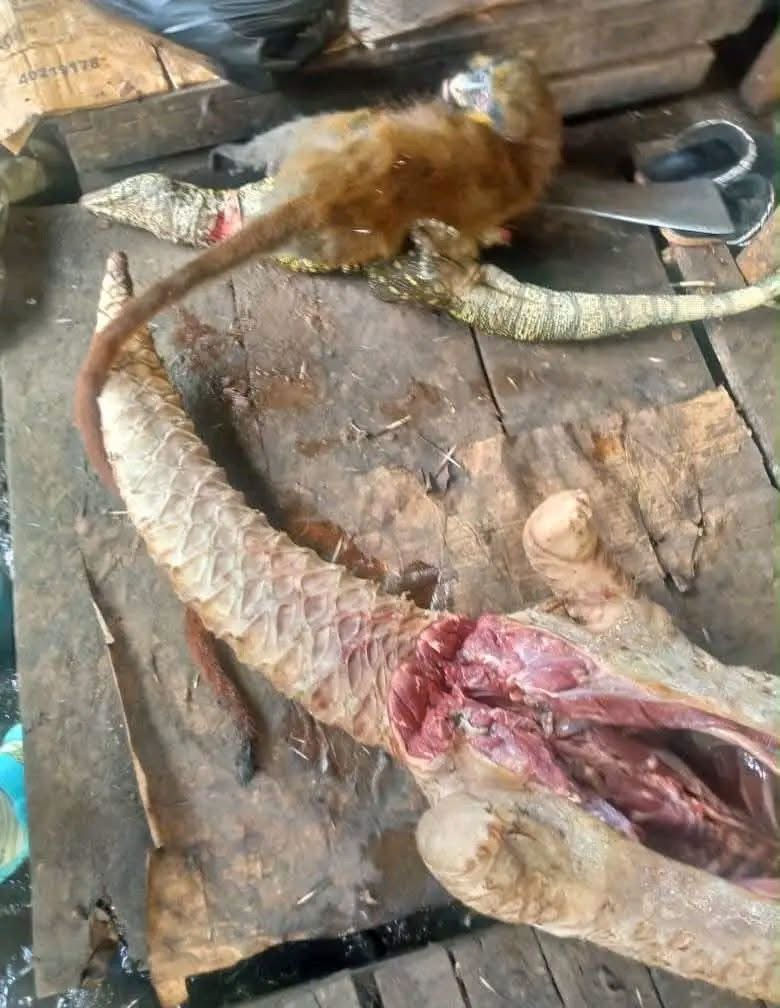
Behind the shipping containers and the spreadsheets is a reality that is difficult to look at. Pangolins are taken from the wild, often alive, and the scenes at the end of that chain are not gentle. Market tables. Butchered animals. Bagged animals. A small, curled body that once rolled itself into a ball for protection, the only defence it has ever known, and which does nothing against a human hand.
I include the images below not to shock, but because looking away is exactly what the trade depends on. If you would rather not see them, skip to the next heading. There is no shame in that.
⚠️ GRAPHIC IMAGES AHEAD The following images show pangolins that have been killed and butchered, along with other animals on market tables. Please skip to the next heading if you would prefer not to see them.


Behind Every Figure, a Life
Let us step back from the tonnes and the dollars for a moment.
Every figure in that report is an individual animal. A pangolin that dug for ants at dusk. An elephant that carried the memory of a whole family. A lioness whose pride is now a little smaller. A rhino that should be walking the savanna rather than being counted in kilograms.
The consequences also reach well beyond the animals who were taken. When you remove pangolins from an ecosystem, you remove the quiet engineers who keep insect populations in check and soil healthy. When you remove apex predators and mega-herbivores, you pull threads out of a tapestry that took millennia to weave. The damage does not stay where it begins.
Pangolins are widely described as among the most trafficked mammals on Earth, and all eight species, four in Africa and four in Asia, are under threat. For an animal that has survived for tens of millions of years, it is a bitter irony that one species of ours may be what finally brings it undone. Conservationists are responding: the IUCN has announced the first-ever regional action plan for African pangolins, and the African Pangolin Working Group continues its research, rescue and education work across the continent.


A Glimmer of Justice: Four Traffickers Convicted
There is, thankfully, a thread of hope running through this report, and it is worth holding on to.
The investigation led to the arrests of four senior traffickers in two countries in 2022. By 2024, each had been convicted and sentenced for wildlife crimes. These were not low-level couriers. These were the people at the top, the ones driving and financing the trade.
Olivia Swaak-Goldman, Executive Director of the Wildlife Justice Commission, put the philosophy behind this approach simply. By targeting the leaders and "following the money", she said, they make wildlife trafficking riskier and less profitable. It is a strategy of disrupting entire networks, not just stopping individual shipments, and it is exactly the kind of thinking this fight needs.
Because here is the truth the report makes plain: you can seize a container, and the network will buy another. But take away the people who finance it, and the whole machine begins to falter. Independent coverage of the wider trend, including Mongabay's report on the post-pandemic slump in trafficking and Daily Maverick's investigation into crime networks in Africa, shows why sustained pressure matters.
Why the Law Alone Is Not Enough
You might wonder how any of this can still be happening when the pangolin is so well protected on paper. It is a fair question, and it deserves an honest answer.
All eight pangolin species have been listed under the strictest level of protection in the international wildlife trade convention, CITES, which bans international commercial trade in them. That was a landmark moment for these animals. But a law is only as strong as the people enforcing it, and the people breaking it are well funded, well organised and patient. Where profit is high and the risk is low, crime finds a way.
That is why the approach described in the report matters so much. Seizing a shipment treats the symptom. Arresting the financiers, tracing the money and convicting the leaders treats the cause. It is slower, harder and far less glamorous, but it is the only thing that has ever truly shaken a criminal network. The report's strongest message is not that we are losing. It is that the right kind of pressure works.
Myths That Keep the Trade Alive
Behind every illegal market is a story people tell themselves. Here are the ones worth setting straight.
"The scales have healing powers." They do not. They are keratin, identical in make-up to your fingernails and to rhino horn. There is no proven medical benefit, only a belief that has cost tens of thousands of animals their lives.
"There are plenty of them." There are not. Pangolins breed slowly, usually one youngster at a time, so a population cannot recover from heavy losses the way faster-breeding species can.
"It is only a few desperate poachers." The report shows otherwise. The people profiting most sit far from the bush, using shell companies, bank accounts and cryptocurrency to stay out of reach.
"One animal will not make a difference." Every animal does. When the population of a slow-breeding, solitary species is already thin, each loss is felt across the whole landscape.
Truth is a quiet but powerful weapon. Every myth we correct takes a little air out of the market.
Rangers, Rescuers and the Quiet Heroes
It would be wrong to tell this story without paying tribute to the people on the other side of it.
Behind every seizure is an investigator who spent months piecing together a trail. Behind every conviction is a prosecutor, a customs officer or a police unit who refused to let a case go cold. And behind every pangolin that makes it back into the wild is someone, often a volunteer, who drove through the night to collect it, kept it calm, and released it where it belonged. Much of this work is unpaid, unseen and unthanked.
These are the people who turn a report like this from a grim list of figures into proof that the fight can be won. They deserve our respect, and they deserve our support.
Why This Matters to Every Traveller
It would be easy to file all of this under "someone else's problem". But if you love Africa, it is yours too.
Every sunrise game drive, every starlit boma dinner and every quiet moment in the bush rests on a living, breathing ecosystem. Pangolins are one small thread in that fabric, but pull enough threads and the whole picture unravels. The lodges, guides, rangers and communities who depend on wildlife-based travel are the first to feel it when the animals disappear, and the last to be thanked for protecting them.
So the next time you plan a journey, think of it as a vote. Where you stay, who you travel with and what you choose to buy all send a message about the kind of Africa you want to still exist in twenty years' time.
Our Part in the Story: Pangolin Conservation at Adventure Lifestyle Magazine
At Adventure Lifestyle Magazine, we have never been content to simply write about conservation from a comfortable distance.
We have done our fair share, being hands-on and involved in the conservation of these magnificent creatures, standing in the field, alongside the people who protect them, and carrying their stories back out into the world. We believe that a travel magazine should do more than show you beautiful places. It should help protect the very things that make them beautiful.
Because that is what wanderlust is really about. It is not only the joy of arriving somewhere breathtaking. It is the responsibility of making sure that it is still breathtaking when your children arrive there too. A bush without its pangolins is a quieter, poorer, lonelier place, and no sunset, however golden, can make up for that.
What You Can Do to Stop Wildlife Trafficking
It is easy to read a report like this and feel small. But small acts, added together, are how the tide turns.
Never buy wildlife products. If something is made from scales, ivory, horn or bone, walk away. Demand is the engine of this trade, and every refusal switches it off a little.
Report what you see. If you come across pangolins or other wildlife being offered for sale, whether in person or online, report it to the relevant authorities rather than engaging with it.
Support the people doing the work. Organisations like the Wildlife Justice Commission and the African Pangolin Working Group investigate, rescue and protect.
Travel with purpose. Choose lodges and operators that genuinely invest in conservation and local communities.
Share the story. Silence is the trafficker's best friend. Talk about it, share it, and keep the conversation alive.
The Last Word
I like to think of the pangolin as a small, ancient poem that the world has been writing for tens of millions of years. Every curl of its tail, every overlapping scale, every careful footstep in the dark is a line in that poem.
It would be a profound shame to let greed erase it.
The report from the Wildlife Justice Commission shows us that these networks can be found, followed and dismantled. Four senior traffickers are now behind bars. The machine is not unbeatable. But it will only be beaten if enough of us refuse to look away.
So let us keep our eyes open. Let us keep telling the stories. And let us keep finding the extraordinary in the mundane, including the quiet, armoured, ant-eating wonder that deserves to walk this earth in peace.
Read More
Wildlife Justice Commission: Disruption and Disarray, 2015-2024
Species Unite podcast: Olivia Swaak-Goldman on taking down wildlife trafficking kingpins
Mail & Guardian: South Africa's pangolins face rising threat as illegal trade grows
Mongabay: Pandemic-era slump in ivory and pangolin scale trafficking persists
Daily Maverick: Wildlife trafficking and crime networks in Africa


Comments